
WH Questions – Why They Are Crucial for Cognitive and Language Growth

A Curious Mind: Aarav's Journey
It was a typical evening at the Sharma household, and five-year-old Aarav was flipping through his favorite picture book. His mother, Riya, watched him with a knowing smile.
“Mumma, why is the sky blue?” Aarav asked, eyes wide with curiosity.
Riya chuckled. “That’s because of the way sunlight scatters in the sky.”
“What is scattering?” he continued, undeterred.
As Riya patiently explained, she realized that many of Aarav’s questions began with ‘why,’ ‘what,’ ‘where,’ ‘who,’ ‘when,’ and ‘how.’ These weren’t just random queries—they were shaping his understanding of the world.
Understanding WH Questions
WH questions are vital for a child’s language and cognitive development. They build curiosity, strengthen problem-solving skills, and enhance interaction. Each type serves a unique role:
-
What – Identifies objects, actions, or people.
-
Where – Builds spatial awareness.
-
Who – Recognizes relationships.
-
When – Introduces time-related concepts.
-
Why – Develops reasoning.
-
How – Encourages logical thinking.
A Turning Point in Speech Development
While Aarav was always full of questions, his cousin Kiran, aged four, was different. He spoke in short phrases but rarely asked questions. His parents assumed it was his personality.
But one day, Riya told her sister Neha, “Kiran doesn’t ask ‘why’ or ‘what’ like Aarav does. Does he follow instructions easily?”
Neha paused. “Come to think of it, he mostly repeats what we say. He doesn’t always respond with his own thoughts.”
Concerned, Neha consulted speech-language pathologist Dr. Mehta, who confirmed that asking WH questions is a critical developmental milestone. Children who don’t engage in question-asking may face challenges in comprehension, vocabulary, or social communication.
The Role of WH Questions in Cognitive Growth
Dr. Mehta explained how WH questions stimulate multiple areas of the brain:
-
Critical Thinking – “Why” and “how” questions encourage connecting ideas.
-
Memory Recall – “When” and “where” help relate to past events.
-
Social Skills – “Who” improves the ability to form and maintain relationships.
-
Problem-Solving – “What” aids in categorization and better decision-making.
With timely intervention and engaging activities, these skills can be nurtured.
Helping a Child Develop WH Question Skills
To support Kiran, Dr. Mehta suggested simple activities:
-
Storytelling & Picture Books – Ask “Who is this?” or “What might happen next?”
-
Daily Conversations – Replace commands with questions: “Where should we go today?”
-
Interactive Play – Use games like I Spy to prompt natural WH question use.
-
Role-Playing – Pretend play scenarios build vocabulary and dialogue.
-
Visual Aids – Use flashcards and vocabulary kits to reinforce learning.
Progress and Breakthrough Moments
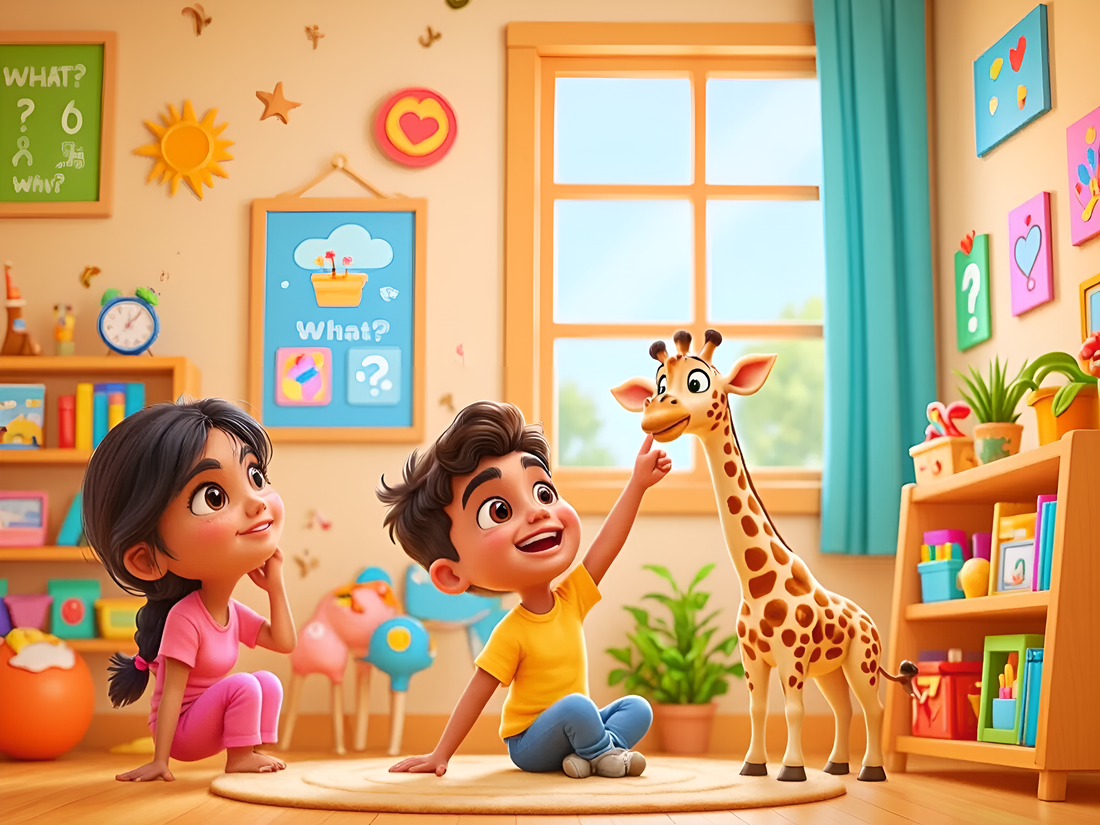
Neha followed these strategies. Gradually, Kiran became more responsive. Then one day, pointing to a giraffe, he asked, “Why does it have a long neck?”
It was a turning point. From that day, he questioned everything—the stars, rain, even why cats purr. With every question, he built vocabulary, reasoning, and confidence.
WH questions aren't just part of conversation—they're the heart of exploration and expression. Encouraging them boosts a child’s curiosity, language, and learning.
If your child isn’t asking WH questions, don’t ignore it. With early support and interactive learning, you can open a world of understanding.