
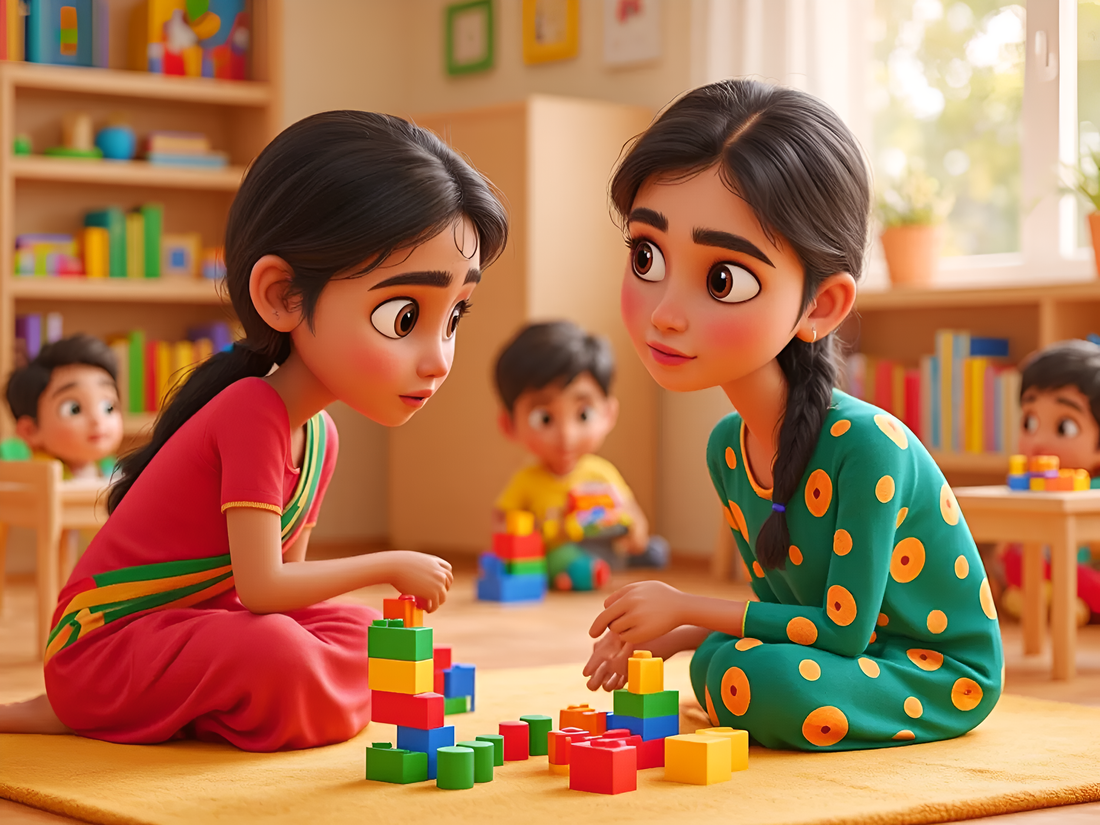
Communication Barriers – Why Some Children Struggle to Speak Clearly The Story of Little Rohan
 Rohan was a bright and curious five-year-old who loved his toy cars and building blocks. His eyes sparkled with excitement whenever he discovered something new. But unlike his peers, Rohan struggled to speak clearly. While others formed sentences with ease, Rohan often stayed silent, frustrated by his inability to express himself.
His parents, Sunita and Raj, noticed his difficulties early on. Initially, they hoped he’d catch up with time. But by the age of four, the gap between Rohan and other children had widened. His words were often unclear, some sounds were missing, and he sometimes avoided speaking altogether. It was heartbreaking to see his confidence dip when others couldn’t understand him.
One day, Rohan’s preschool teacher, Ms. Priya, gently approached Sunita.
“I’ve noticed Rohan has trouble with certain sounds,” she said kindly. “Have you considered seeing a speech therapist?”
Sunita admitted they were concerned and ready to take action. Ms. Priya encouraged them, saying, “Many children face communication challenges. Early help can make a big difference.”
Soon after, Sunita and Raj consulted a speech-language pathologist (SLP), Dr. Meera, who explained that communication barriers can arise from several causes.
Understanding Communication Barriers in Children
Rohan’s struggle isn’t uncommon. Children may have difficulty speaking clearly due to:
-
Speech Sound Disorders
-
Articulation Disorders: Difficulty pronouncing specific sounds (e.g., “wabbit” for “rabbit”).
-
Phonological Disorders: Patterns of errors like dropping final consonants.
-
Language Delays
-
Trouble forming sentences or understanding instructions.
-
Limited vocabulary compared to peers.
-
Hearing Impairments
-
Undiagnosed hearing issues can affect sound recognition and speech clarity.
-
Neurological Conditions
-
Conditions like autism, apraxia of speech, or cerebral palsy may affect speech production.
-
Environmental Factors
-
Limited interaction, screen overuse, or fewer verbal exchanges can delay development.
Steps Toward Progress
Dr. Meera crafted a personalized plan for Rohan. The therapy focused on making speech learning fun and engaging. She emphasized:
-
Early Intervention
Addressing issues early allowed for faster progress. Rohan practiced sounds in short, enjoyable sessions. -
Parent Involvement
Sunita and Raj became active partners. They encouraged Rohan to name things instead of pointing. If he said “tar,” they’d respond, “Yes! A red car.” -
Speech-Friendly Activities
Dr. Meera used picture cards, storytelling, and rhymes to strengthen Rohan’s speech in a playful way. -
Positive Environment
Ms. Priya encouraged group activities that didn’t highlight Rohan’s difficulties. Instead, she praised his creativity and kindness. -
Building Confidence
At home, Rohan was never shamed for mispronunciations. Every attempt was celebrated, building his self-esteem.
Rohan’s Breakthrough
Months passed. One day, during a class storytelling activity, Rohan stood up and described his favorite toy car. His speech wasn’t perfect, but he was understood—and applauded.
That evening, he excitedly told his mother, “Mama, I told a story today! Everyone listened to me!”
Sunita’s eyes filled with tears. “I’m so proud of you,” she whispered, hugging him tight.
Every child develops at their own pace, but if you notice persistent struggles in speech, early support is essential. Rohan’s journey shows how, with timely intervention and love, children can overcome communication barriers and find their voice.